Elena Bajo

Artist Statement

My practice positions plants as active collaborators and sentient agents within ecological and ancestral systems. Drawing from my matrilineal Galician heritage—where my grandmother taught me to recognize plants as healers and teachers—I engage with Celtic druid cosmologies, treating plants as living instructors that inform each phase of my process. This echoes Karen Barad's concept of intra-action, where boundaries between human and more-than-human dissolve. My work blurs art, science, and ritual through sculptural interventions, choreographies, textile+AI, and video. I invite encounters that honor ancestral wisdom alongside contemporary ecological urgency. Each project is site-responsive, guided by attentive listening and respectful kinship with the living land. Through embodied practice rooted in my mother's sidewalk choreographies—translating landscape into movement—I cultivate spaces that nurture encounters between human and more-than-human consciousness. At Marble House Project, I propose deepening this commitment: making kin with White Oak and Mugwort as teachers, creating installations and rituals that prototype alternative futures rooted in reciprocity and ecological care.
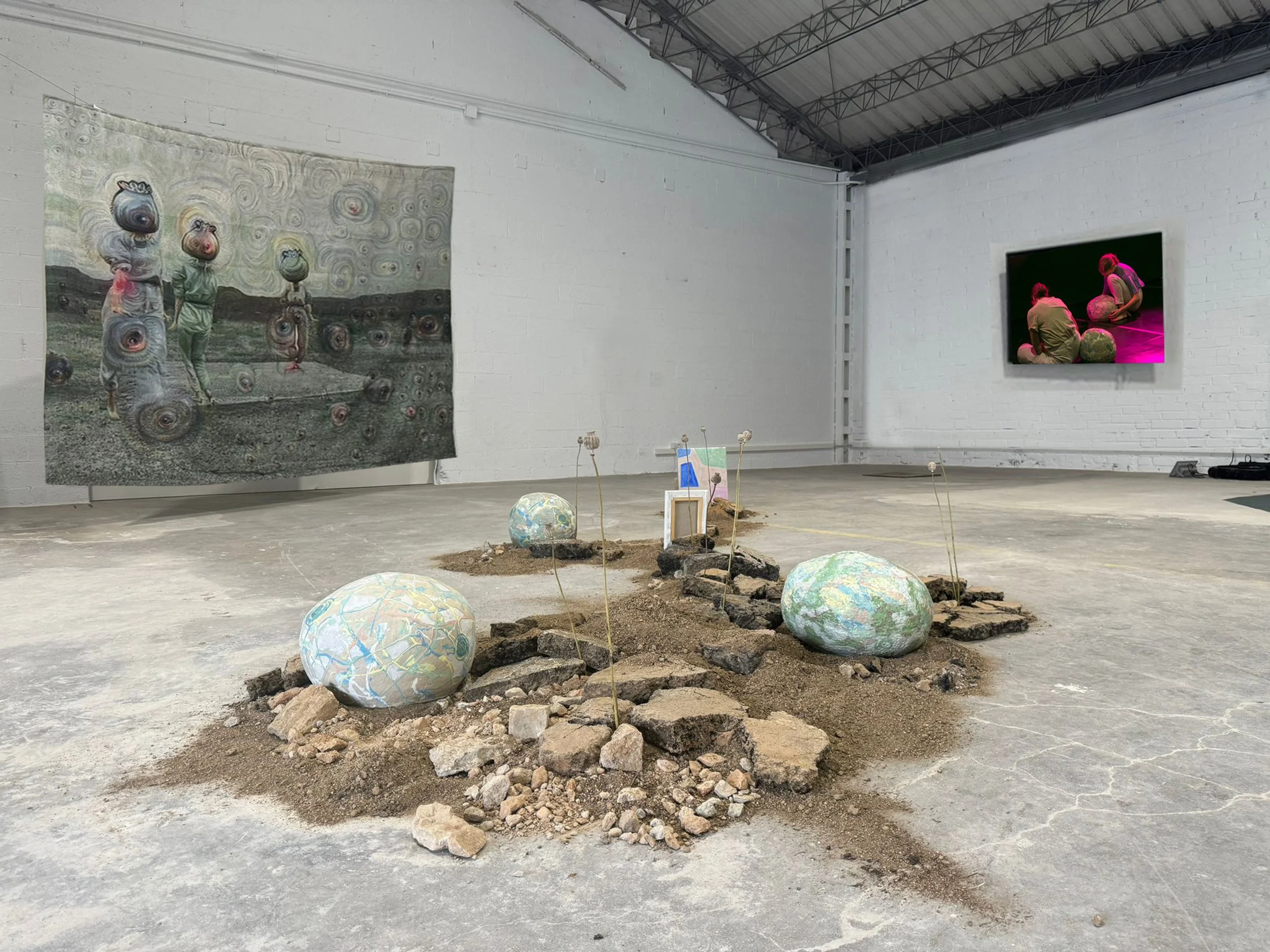
Description: "A Growing Wave Breaks in the Shore of Time (Tomorrow I was a plant)," 2020–2024. Multi-element performative installation, variable dimensions. Curator Nuria Montclus, Commission for Manifesta 15 Biennial, Barcelona, Spain (2024) — Europe's premier nomadic contemporary art biennial. This expansive site-responsive installation transforms gallery space through a constellation of ceramic, plants, stone, rubble, textile, and performative elements that activate Karen Barad's concept of "intra-action"—the radical entanglement of human, more-than-human, and material agencies. At the installation's core rest three monumentally scaled iridescent ceramic spheres (resembling seeds, eggs, or planetary bodies), nested within sand and reclaimed stone, creating what appears as ancient ceremonial thresholds while simultaneously evoking speculative futures shaped by deep time geological consciousness. The work materializes Bajo's "anarchoreographic" methodology—a non-hierarchical, decentered approach to performance and spatial organization that refuses traditional choreographic hierarchy. Textile banners suspended within the installation (woven using Jacquard looms, proto-digital machines that translate code into cloth) feature AI-processed patterns derived from the artist's altered-consciousness drawings, creating a transmaterial dialogue between ancestral knowledge, algorithmic intelligence, and botanical consciousness. The iridescent ceramic surfaces shift chromatically as viewers navigate the space, echoing both Byzantine-era cosmological symbolism and contemporary quantum aesthetics. During Manifesta 15's four-month presentation (100,000+ visitors), the installation was publicly activated through meditative encounters where visitors engaged in "transcorporeal choreographies"—embodied practices that dissolved boundaries between human movement and plant temporality. The work proposes plants not as passive landscape elements but as "narrators of their own history" and alternative epistemologies for understanding deep time, ecological resilience, and more-than-human collaboration. Materials: Reclaimed rubble from local industrial decay, stones, sand, ceramic vessels (hand-glazed with iridescent finishes), jacquard loom textiles with AI-generated patterns, dried papaver capsules, liquid extract, plant parts, seeds,leaves, flowers, seeds, water elements, plant opium perfume, acrliyc and watercolor plant pigment on canvas, performative installation.
Bio

Elena Bajo is a Spanish-American artist, choreographer, and educator whose transdisciplinary practice explores plant consciousness, ancestral knowledge, and ecological transformation through sculpture, performance, textiles, video and AI collaboration. Her artistic vision is rooted in matrilineal Druid-Celtic heritage. Bajo redefines posthuman ecologies through "transcorporeal choreographies," positioning human, more-than-human, and machine intelligence as equal co-authors. Her work has been exhibited internationally recent commissions include Manifesta 15 Barcelona (2024) and SkulpturenPark Wesenberg, DE (2024); Socrates Sculpture Park, NY; Casa Encendida, Madrid; Conde Duque, Madrid; Kunsthalle São Paulo; ARTIUM Museum, ES; Performa Biennial, NY; Bajo’s work is featured in major public and private international collections and has appeared in publications such as Artforum , Frieze, Flash Art, ABC Cultural, El Pais, The New York Times and Künstler Kritisches Lexikon der Gegenwartskunst. She has received major support from grants and fellowships including the LMCC Art Center Residency (2023), Matadero Madrid Residency (2022), Rauschenberg Emergency Grant (2022), Foundation for Contemporary Art NY Emergency Grant, Mondriaan Fund, Audemars Piguet Award (2017), and Botín Foundation International Visual Arts Grant (2018). Trained in fine arts (Central Saint Martins, London), pharmacology (Complutense University), and genetic architecture (ESARQ UIC Barcelona), her practice bridges Laban/Bartenieff movement studies (TanzFabrik Berlin) with plant consciousness research. She is founder of S.L.A.B Project, an ecological art platform in Wonder Valley, California. Currently Coordinator of Integrative Art Studies at Saas-Fee Summer Institute of Art (New York & Paris). As First Place Fellow for 2026 at C3A, Center for Comporary Art in Córdoba, Spain, she is currently developing "Al-Andalus Quantum Artemisia Dreams: Time Weaver"—a major installation exploring plant consciousness through ancestral Iberian ceramic and textile traditions.


http://www.elenabajo.com


Jennifer Shin

Artist Statement

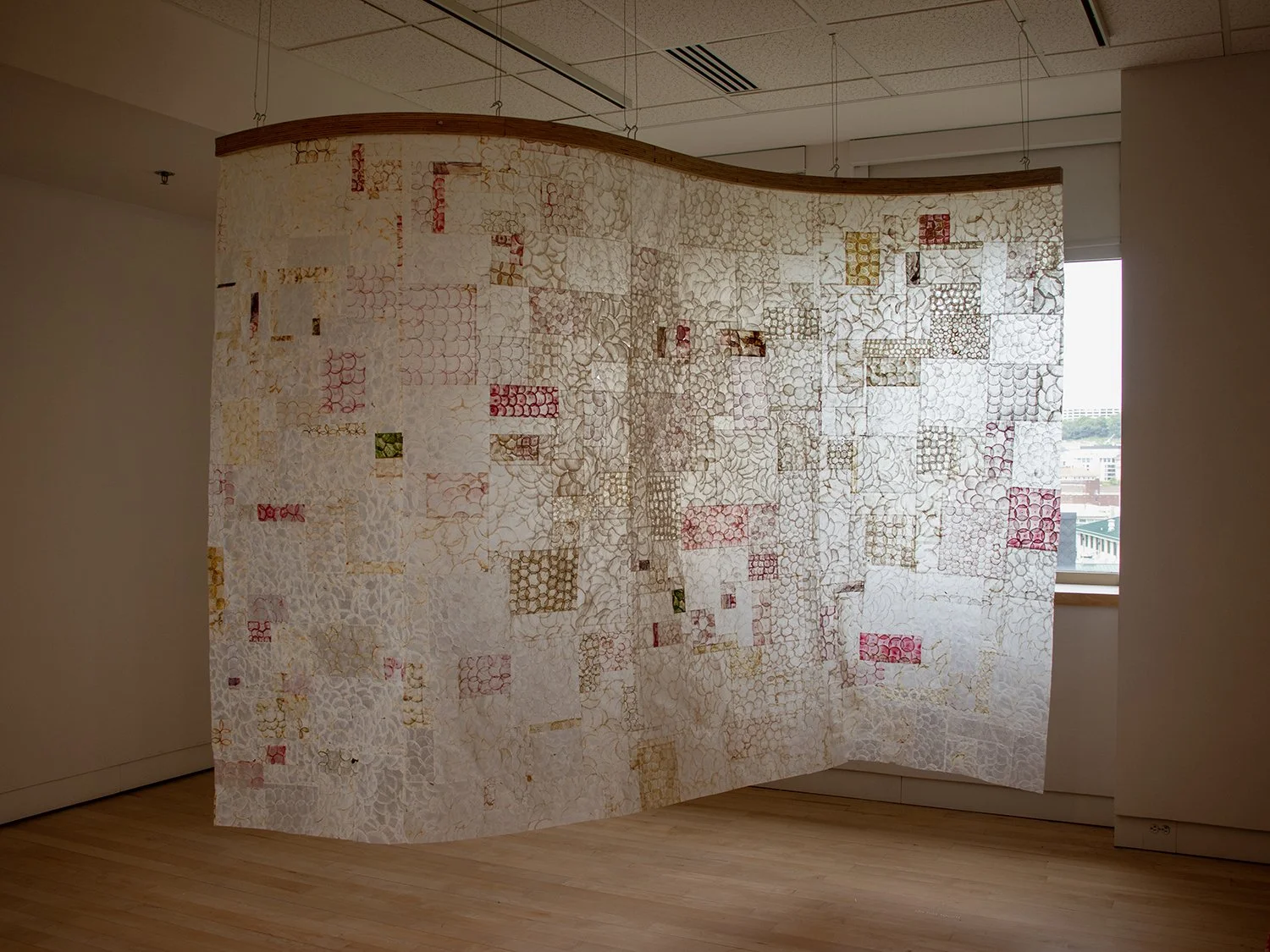
I work with food and craft to explore care, time, and the lives of ephemeral materials. Seasonal produce is central to my process; I transform fruits and vegetables into paper-like sheets that are pieced together into quilts, bound into books, or shaped into sculptural objects. This act of preservation extends what is fleeting, drawing from traditions of fermentation and food saving as ways of holding memory. In parallel, I approach cooking as a tactile, communal craft. Through edible installations and shared meals, I treat the table as a studio where ingredients become gestures to reflect on impermanence, care, and the everyday acts that sustain us. Across these practices, I consider how food carries emotional and cultural histories, becoming both nourishment and archive. My work lingers on what materials leave behind, asking how we might honor what passes while building community through small, shared moments.

Jennifer Shin / Sound x Taste tablescape for FUSION, 2024, Photo credit: Troxum

Bio

Jennifer Shin is an interdisciplinary artist based in Seoul and New York. Working with food and paper, she explores how fleeting materials carry memory, whether through handcrafted objects or shared meals. Alongside her paper-making practice, she cooks and organizes communal food gatherings where food becomes a medium for connection and care. She received her BFA from Carnegie Mellon University in 2024. Her work has appeared in exhibitions and community programs at the Miller ICA, Pittsburgh Cultural Trust, and The Folly Tree Arboretum, as well as in publications and features including Robida, Produce Parties, Art and Type Magazine, and the menu card series for the Michelin-starred restaurant Atomix.


https://jennifershinart.com